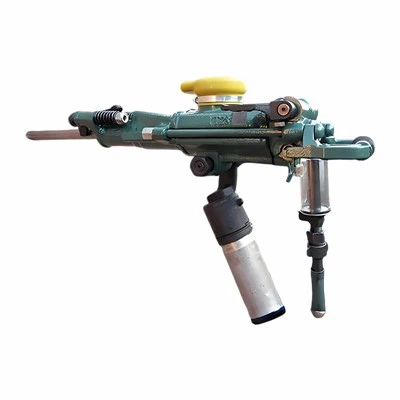
As a supplier of Pneumatic Mine Rock Drills, I've had the privilege of witnessing the evolution and application of different types of rock drills in the mining industry. One of the most common questions I encounter is about the differences between pneumatic mine rock drills and hydraulic rock drills. In this blog, I'll delve into these differences to help you make an informed decision when choosing the right rock drill for your mining operations.
Working Principle
The fundamental difference between pneumatic and hydraulic rock drills lies in their working principles. A Pneumatic Mine Rock Drill operates using compressed air. Compressed air is supplied to the drill, which then drives a piston back and forth. This reciprocating motion of the piston generates the impact force needed to break through the rock. The air is typically provided by an air compressor, which can be located either on - site or remotely.
On the other hand, a hydraulic rock drill uses hydraulic fluid to generate power. A hydraulic pump pressurizes the fluid, which is then directed to the drill's hydraulic cylinders. The pressure of the fluid causes the piston in the drill to move, creating the impact force. The hydraulic system offers more precise control over the drilling process compared to the pneumatic system.
Power and Efficiency
In terms of power, hydraulic rock drills generally have an edge over pneumatic ones. Hydraulic systems can generate higher pressures, which translates into greater impact force. This makes hydraulic rock drills more suitable for hard rock formations and large - scale mining operations. They can drill deeper and faster, reducing the overall drilling time and increasing productivity.
Pneumatic mine rock drills, while not as powerful as hydraulic ones, are still very effective for many mining applications. They are more lightweight and easier to handle, which makes them ideal for smaller - scale operations or areas where mobility is crucial. However, their power output is limited by the capacity of the air compressor. If the compressor cannot supply enough compressed air, the drill's performance will be affected.
Mobility and Portability
Mobility is an important factor in mining operations. Pneumatic mine rock drills are known for their portability. They are relatively lightweight and can be easily moved from one location to another. This makes them a popular choice for mining operations in remote areas or where the drilling location changes frequently. A Pneumatic Jack Hammer, which is a type of pneumatic rock drill, is often used for handheld applications and can be carried by a single operator.
Hydraulic rock drills, on the other hand, are usually heavier and less portable. They require a hydraulic power unit, which can be large and cumbersome. However, modern hydraulic rock drills are becoming more compact and mobile, with some models designed for easy transportation.
Maintenance and Cost
Maintenance is another aspect where the two types of rock drills differ. Pneumatic mine rock drills have a relatively simple design, which makes them easier to maintain. They have fewer moving parts compared to hydraulic rock drills, and the components are generally less expensive to replace. The main maintenance task for pneumatic drills is to ensure that the air compressor is working properly and that the air lines are free of blockages.
Hydraulic rock drills, due to their more complex hydraulic systems, require more maintenance. The hydraulic fluid needs to be regularly checked and changed, and the hydraulic components need to be inspected for leaks and wear. The cost of maintaining a hydraulic rock drill can be higher than that of a pneumatic one, especially in the long run.
In terms of initial cost, pneumatic mine rock drills are generally more affordable. They are a cost - effective option for small - to medium - sized mining operations. Hydraulic rock drills, on the other hand, are more expensive upfront due to the cost of the hydraulic power unit and the more advanced technology. However, in large - scale operations where productivity is a key factor, the higher initial investment in a hydraulic rock drill may be justified.
Environmental Impact
The environmental impact of the two types of rock drills is also different. Pneumatic mine rock drills produce noise during operation. The compressed air being released can create a loud noise, which can be a nuisance to workers and nearby communities. However, modern pneumatic drills are designed with noise - reducing features to minimize this impact.
Hydraulic rock drills, while generally quieter than pneumatic ones, can pose a risk of hydraulic fluid leakage. If not properly managed, the hydraulic fluid can contaminate the soil and water. Therefore, proper maintenance and handling of the hydraulic system are crucial to minimize the environmental impact.
Application Suitability
Pneumatic mine rock drills are well - suited for a variety of applications. They are commonly used in small - scale mining, such as artisanal mining and small quarry operations. Their portability and relatively low cost make them a popular choice for these types of operations. They are also used for tasks such as drilling holes for blasting in mines.
Hydraulic rock drills are more commonly used in large - scale mining operations, such as open - pit mines and underground mines. Their high power and efficiency make them ideal for drilling deep holes in hard rock formations. They are also used in tunneling projects and large - scale construction projects where high - performance drilling is required.


Conclusion
In conclusion, both pneumatic mine rock drills and hydraulic rock drills have their own advantages and disadvantages. The choice between the two depends on various factors such as the scale of the mining operation, the type of rock formation, budget, and mobility requirements.
If you are looking for a cost - effective, portable, and easy - to - maintain option for small - scale mining or light - duty drilling tasks, a Pneumatic Mine Rock Drill may be the right choice for you. On the other hand, if you are involved in large - scale mining operations and need high - power, high - efficiency drilling, a hydraulic rock drill may be more suitable.
If you have any questions or are interested in purchasing a Pneumatic Mine Rock Drill or any other Rock Drilling Machine, feel free to reach out to us. We are here to assist you in making the best decision for your mining needs.
References
- Smith, J. (2018). Mining Equipment Handbook. Elsevier.
- Johnson, R. (2020). Rock Drilling Technology. Wiley.
- Brown, A. (2019). The Future of Mining: Trends and Innovations. Springer.