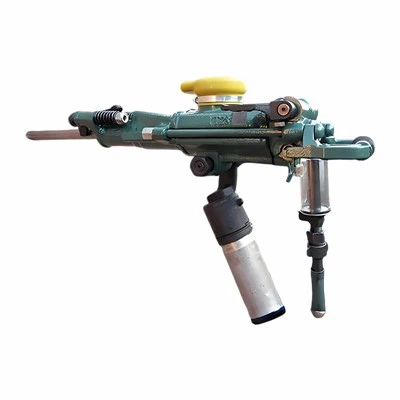
As a reputable air leg rock drill supplier, I often receive inquiries from customers about the emergency stop mechanism of our products. In this blog, I will delve into the details of what the emergency stop mechanism of an air leg rock drill is, its importance, and how it works.
The Significance of the Emergency Stop Mechanism
The emergency stop mechanism is a crucial safety feature in air leg rock drills. These drills are powerful tools used in various industries such as mining, construction, and quarrying. During operation, unexpected situations can arise, such as a malfunction, a sudden change in the working environment, or an operator's error. In such cases, the emergency stop mechanism provides a quick and reliable way to halt the drill's operation, preventing potential accidents and injuries.
How the Emergency Stop Mechanism Works
The emergency stop mechanism in an air leg rock drill typically consists of a combination of mechanical and pneumatic components. When the emergency stop button is pressed, it triggers a series of actions that cut off the power supply to the drill and stop its movement.
Mechanical Components
The mechanical part of the emergency stop mechanism usually includes a lever or a button that, when activated, disengages the drill's drive system. This can involve disconnecting the power transmission from the motor to the drill bit, effectively stopping the rotation of the bit. For example, in some air leg rock drills, the emergency stop lever is connected to a clutch mechanism. When the lever is pulled, the clutch disengages, and the drill bit stops spinning.
Pneumatic Components
Since air leg rock drills are powered by compressed air, the pneumatic system also plays a vital role in the emergency stop mechanism. When the emergency stop button is pressed, it closes a valve in the pneumatic circuit, cutting off the supply of compressed air to the drill. Without the air pressure, the drill's piston stops reciprocating, and the drill ceases to operate.
Types of Emergency Stop Mechanisms
There are different types of emergency stop mechanisms used in air leg rock drills, each with its own advantages and applications.
Manual Emergency Stop
This is the most common type of emergency stop mechanism. It consists of a clearly marked button or lever that the operator can easily reach and press in case of an emergency. Manual emergency stops are simple and reliable, and they give the operator direct control over the drill's operation.
Automatic Emergency Stop
Some air leg rock drills are equipped with automatic emergency stop systems. These systems are designed to detect abnormal conditions, such as excessive vibration, overheating, or a sudden drop in air pressure. When such conditions are detected, the system automatically activates the emergency stop, ensuring the safety of the operator and the equipment.
Case Studies: Our Air Leg Rock Drills
At our company, we offer a range of high - quality air leg rock drills, including the YT28 Air Leg Rock Drill, YT29A Rock Drill, and YT27 Rock Drill. Each of these drills is equipped with a reliable emergency stop mechanism.
The YT28 Air Leg Rock Drill is a popular choice for medium - to large - scale rock drilling operations. Its emergency stop mechanism is designed for quick and easy activation, allowing the operator to stop the drill immediately in case of an emergency. The manual emergency stop button is prominently located on the drill's handle, ensuring that it can be easily reached.


The YT29A Rock Drill is known for its high - performance and durability. It features an automatic emergency stop system that monitors the drill's operating parameters. If any abnormal conditions are detected, the system will automatically stop the drill, protecting the operator and the equipment from potential damage.
The YT27 Rock Drill is a compact and lightweight option, suitable for smaller - scale drilling tasks. Its emergency stop mechanism is simple yet effective, providing a reliable way to halt the drill's operation when needed.
Maintenance and Inspection of the Emergency Stop Mechanism
To ensure the proper functioning of the emergency stop mechanism, regular maintenance and inspection are essential. Here are some key points to keep in mind:
- Visual Inspection: Regularly check the emergency stop button or lever for any signs of damage, such as cracks or loose connections. Make sure it is clean and free from debris.
- Function Test: Periodically test the emergency stop mechanism to ensure that it is working properly. This can be done by pressing the emergency stop button while the drill is running (in a safe environment). The drill should stop immediately.
- Lubrication: If the emergency stop mechanism has moving parts, such as levers or clutches, lubricate them regularly to ensure smooth operation.
Conclusion
The emergency stop mechanism is an essential safety feature in air leg rock drills. It provides a quick and reliable way to stop the drill's operation in case of an emergency, protecting the operator and the equipment. At our company, we are committed to providing high - quality air leg rock drills with reliable emergency stop mechanisms.
If you are in the market for an air leg rock drill, we invite you to contact us for more information. Our team of experts is ready to assist you in selecting the right drill for your specific needs and to answer any questions you may have about the emergency stop mechanism or other features of our products. We look forward to the opportunity to work with you and help you achieve your drilling goals safely and efficiently.
References
- "Handbook of Rock Drilling Equipment", various authors, [Publisher Name], [Year]
- "Safety Standards for Construction and Mining Equipment", [Standard Organization], [Year]