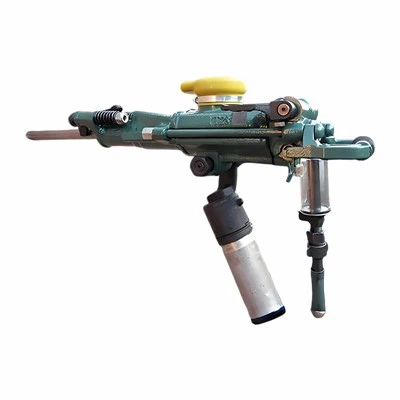
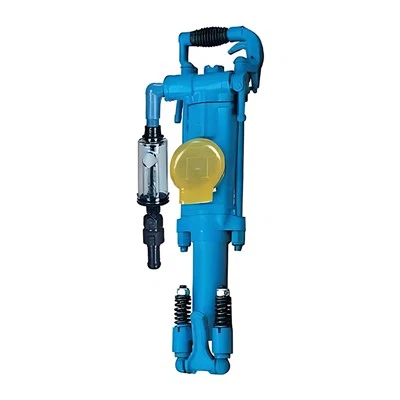
The design principle of rock drilling tools is based on a deep understanding of the rock breaking mechanism. Through the coordinated configuration of mechanical structure and power system, the input energy is efficiently converted into destructive force acting on the rock at the bottom of the hole, thereby achieving rapid hole formation and stable operation. Essentially, it utilizes impact, rotation, and combined actions to induce cracks and spalling in the rock under stress concentration and shearing. The entire design revolves around energy transfer, stress matching, and adaptation to working conditions.
From the perspective of rock breaking mechanism, the compressive strength of rock is much higher than its tensile and shear strength. This characteristic is often utilized in the design. Impact generates transient high-pressure stress waves at the bottom of the hole, forming radial and circumferential cracks within the rock. Subsequently, rotation or continuous impact causes the cracks to expand and penetrate, ultimately expelling the rock fragments from the hole under axial thrust. Based on lithological differences, tools can be divided into impact-dominant, rotation-cutting-dominant, and impact-rotation combined-dominant types, corresponding to different stress action modes and slag removal methods.
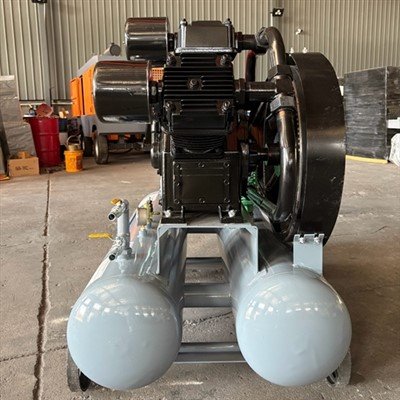
The power transmission structure is the core element of the design. Pneumatic rock drilling tools use compressed air as a power source. Airflow is controlled by a distribution valve to alternately enter the two chambers of the cylinder, driving the piston in a high-frequency reciprocating motion, converting air pressure energy into impact energy. Hydraulic rock drilling tools, on the other hand, use a hydraulic pump to output high-pressure oil, driving the impact piston and rotary motor, combining the advantages of high torque and controllable impact frequency. Both power types require solutions to energy conversion efficiency, the matching of impact energy and frequency, and the low friction and high reliability of the moving parts.
The actuator design must consider the coordination between the impact end and the rotating end. The contact pair between the piston and the drill bit at the impact end must have high wear resistance and fatigue resistance; the stroke and mass determine the magnitude of the single impact energy. The rotating end transmits rotational motion to the drill rod through gears or splines, ensuring stable transmission even under impact reaction forces. The design of the propulsion and guiding mechanisms must ensure that the drill rod axis is aligned with the hole axis to avoid misalignment leading to drill jamming or irregular hole shape. Adjustable axial force control ensures optimal matching of impact and rotational actions.
The auxiliary system design reflects consideration of adaptability to working conditions. The water supply system injects clean water into the bottom of the borehole to cool the drill bit and suppress dust and rock cuttings. Its flow rate and pressure must be matched to the impact frequency. The lubrication system continuously supplies oil mist or hydraulic oil to the moving parts to reduce wear and maintain sealing. Noise reduction and vibration damping structures reduce the adverse effects of noise and vibration on operators and the equipment itself.
In modern design, the introduction of sensors and control units extends the principle from simple mechanical energy output to intelligent regulation. By monitoring parameters such as impact frequency, rotational torque, propulsion force, and temperature in real time, the control system can dynamically adjust power output and operating parameters to adapt to different rock types and working conditions, maintaining efficient rock breaking and low-loss operation.
Overall, the design principle of rock drilling tools is based on rock mechanics. Through power conversion, impact and rotation coordination, propulsion guidance, and auxiliary system integration, it achieves efficient energy utilization and adaptive working conditions, providing a reliable means of rock breaking and borehole formation for mining and geotechnical engineering.