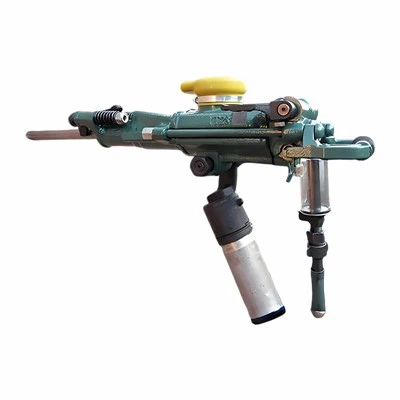
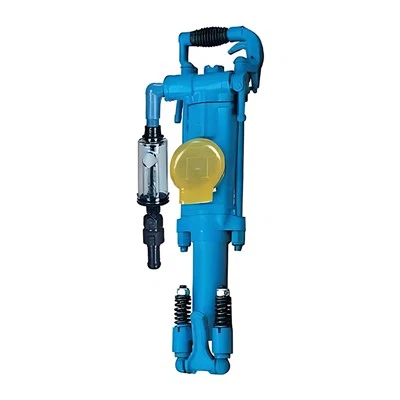
Overall Composition: A typical rock drill consists of a power unit, impact mechanism, rotating mechanism, propulsion and clamping system, flushing and dust removal system, damping and lubrication system, and housing and connection interfaces. The power unit provides energy (such as hydraulic oil, compressed air, or electricity); the impact mechanism converts energy into high-frequency impact power; the rotating mechanism drives the drill bit to rotate for continuous rock breaking and dust removal; the propulsion and clamping system provides controllable axial thrust and ensures reliable drill bit connection; the flushing and dust removal system is used for dust suppression and slag removal; the damping and lubrication system improves lifespan and stability; the housing and interfaces enable assembly of the entire machine, the import and export of power and media, and connection to the drill arm or trolley.
Core Components and Working Mechanism: The impact mechanism is the core of the machine's rock-breaking action. It typically uses a cylinder-piston or hydraulic impactor circuit with a reversing valve and accumulator to achieve high-frequency impact of the piston on the drill bit. The rotation mechanism usually consists of a hydraulic motor and gearbox, whose output torque drives the drill rod and drill bit to rotate continuously, achieving cuttings removal and hole formation. The propulsion and clamping system consists of a propeller (cylinder/chain/screw pair) and a clamp/drill bit clamping mechanism, providing and regulating axial thrust and clamping force to ensure drilling stability and energy transfer efficiency. The flushing and dust removal system performs both dust suppression and slag removal functions. Hydraulic rock drills commonly use side-mounted water injection (typical parameters: inlet pressure approximately 8–12 bar, flow rate approximately 1500 L/h) and are equipped with oil mist air intake (typical exhaust volume approximately 6000 L/h). (L/h) for sealing and lubrication; buffer and vibration damping structures (such as buffer pistons and high-pressure accumulators) absorb rebound impacts, reducing dynamic loads on the machine body and drilling tools; lubrication and dust prevention structures reduce wear and dust intrusion through oil passages and seals, ensuring long-term reliable operation.
Typical Structural Types and Differences
By power source: Hydraulic rock drills are driven by high-pressure oil, featuring high power density, low noise, and high efficiency. Their structure includes complete subsystems for impact, rotation, water supply and dust removal, buffering, lubrication, and dust prevention. Pneumatic rock drills are powered by compressed air, and their structure consists of a cylinder-piston assembly, air distribution device, drill bit rotation mechanism, control valve, and flushing-blowing system. Based on support method, they are further divided into handheld, pneumatic-legged, upward-facing (telescopic), and rail-mounted types. Electric rock drills are driven by an electric motor via a crank-connecting rod or equivalent mechanism for impact drilling, and work in conjunction with a dust removal mechanism to achieve continuous drilling. Internal combustion rock drills use a small internal combustion engine to provide impact energy, suitable for scenarios without electricity or air supply, and are compact and highly mobile.
Interface Structure with Drilling Rigs
In mechanized construction, rock drills are mostly mounted on drilling rigs via a drill arm-pusher-rotor column. The drill arm commonly operates in rectangular coordinates, with the boom cylinder, swing arm cylinder, pitch cylinder, tilt cylinder, and compensation cylinder working together to achieve positioning and multi-directional drilling; the thruster provides reversible axial thrust and can be infinitely speed-adjustable; the slewing mechanism can be a swing-type rotary column or a helical-type rotary column; the whole machine also includes a car body and running gear (rail wheels, tires, or tracks), hydraulic/power/water/air supply systems, and a control panel, forming a complete work chain from positioning, propulsion, slewing, and drilling.